AFCON 2025
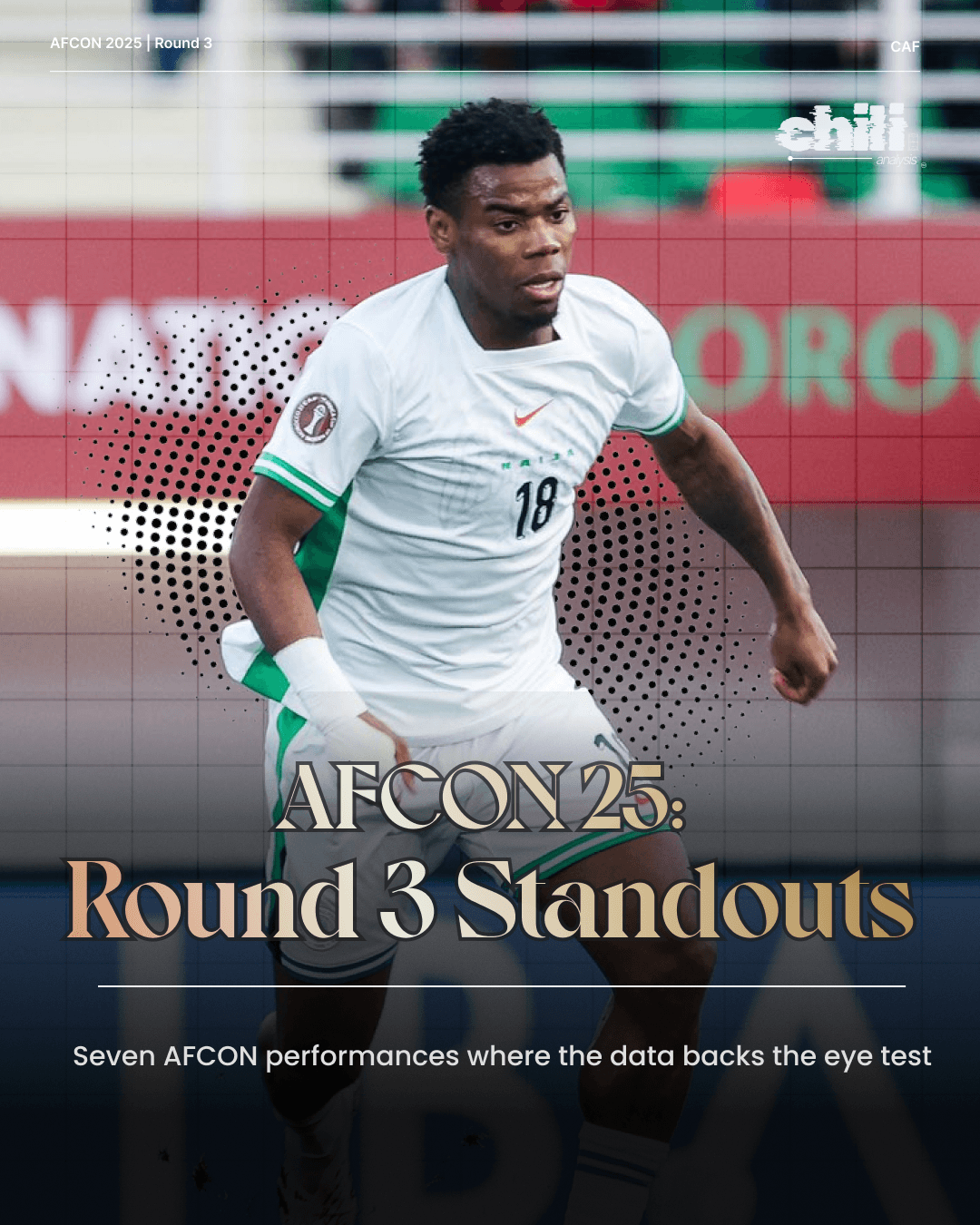
AFCON 2025: Round 3 Standouts
Final group-stage round showcases defining continental performances and tactical evolution.
Published December 31, 2025
By ChiliAnalysis Lab
Group-Stage Conclusion
The final group stage round demonstrated a shift from exploratory usage patterns toward consolidated tactical roles. Defensive midfielders increasingly functioned as dual-phase connectors, while wide players were utilised as structured progression outlets rather than isolated 1v1 attackers.
Across fixtures, three stable role clusters emerged: Central stabilising pivots with progression responsibility, wide progression references under structured build-up systems, and low-volume, high-efficiency central finishers These profiles indicate a transition into knockout phases where repeatability and structural reliability outweigh isolated output events.

Raphael Onyedika
Onyedika operated as a high-efficiency pivot with dual-phase output in Nigeria’s group-stage fixture. He completed 70 of 72 passes, recording a 97% pass completion rate while serving as the primary distribution outlet with 60 total passes received. This confirms his centrality in Nigeria’s build-up structure rather than a secondary recycling role. Beyond circulation, he contributed direct attacking output with 2 goals from 2 shots, indicating late-arrival positioning into advanced zones rather than sustained attacking involvement. The profile reflects a defensive midfielder functioning as both structural anchor and secondary attacking presence through timing rather than volume.

Samuel Chukwueze
Chukwueze functioned as a primary wide progression reference point for Nigeria, with emphasis on spatial attraction rather than final output. He recorded 69 passes received and 36 final-third involvements, indicating consistent use as an outlet in advanced right-sided zones. His 1.34 xT received highlights a high level of progression responsibility, with teammates consistently directing play through his area to access higher-value attacking zones. He also contributed 4 key passes, reinforcing his role as a progression initiator in the final third rather than an isolated winger.

Ayoub El Kaabi
El Kaabi’s performance was defined by low involvement volume combined with high conversion efficiency. He recorded 22 total involvements but converted 2 goals from 3 shots on target, with an xGOT baseline of 0.64. This indicates conversion above expectation rather than high opportunity volume. His profile is consistent with a penalty-box finisher whose impact is driven by positioning efficiency and timing rather than build-up contribution. The performance reflects a striker operating primarily as a final-touch executor within limited interaction environments.

Gaël Kakuta
Kakuta operated as DRC’s primary advanced creation hub, with responsibility concentrated in high-risk distribution zones. He recorded 26 attacking-zone involvements and 14 passes into the final third, alongside 2 goals and 1 assist. This reflects a high-volume creative role despite lower overall pass completion (69.7%). His profile is defined by risk-tolerant progression into congested attacking spaces rather than controlled circulation. The performance reflects a central creator functioning through vertical disruption rather than possession stability.

Christ Inao Oulaï
Oulaï provided structural balance in Ivory Coast’s 3–2 win over Gabon through high-volume midfield activity. He recorded 85 total ball involvements and maintained 94% pass accuracy, operating as a stabilising connector between defensive and attacking phases. Defensively, he added 8 actions including key recoveries that disrupted opposition transition phases. His role reflects a high-workrate central midfielder responsible for maintaining structural continuity during high-transition match conditions.

Ibrahim Maza
Maza produced a high-efficiency attacking output within a limited 61-minute appearance. He contributed 2 goal involvements and 3 key passes from 48 total involvements, indicating strong per-minute attacking productivity. His passing accuracy of 81.8% in advanced zones reflects controlled execution under final-third pressure rather than high-volume accumulation. The profile indicates an attacking midfielder with strong impact density and vertical decision-making efficiency.

Oswin Appollis
Appollis functioned as a high-involvement wide progression outlet for South Africa, combining receiving volume with forward penetration. He recorded 42 passes received and 33 final-third involvements, alongside 11 progressive passes, indicating consistent use as an attacking reference point in wide zones. His 1.05 xGOT output reflects consistent access to high-quality shooting opportunities rather than speculative attempts. The performance profile aligns with a wide player contributing both progression and direct attacking output within structured attacking phases.